
Coco Peat vs Compost vs Vermicompost: What Should You Use in Pots?
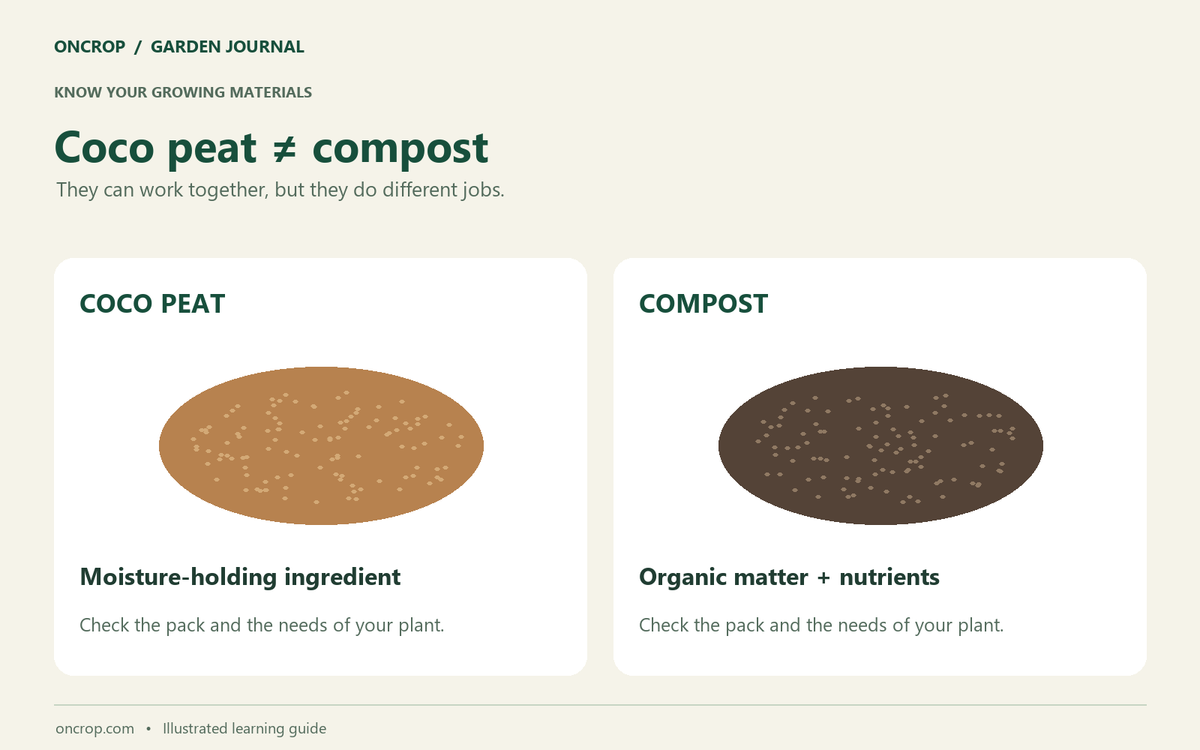
Coco peat is mainly a moisture-holding growing-medium ingredient. Compost and vermicompost add decomposed organic matter and contribute nutrients. They can be used together in a suitable potting mix, but they are not interchangeable. The right choice depends on what is already in the pot and what the plant needs.
If you have been searching for the “best” of the three, start with a more useful question: are you choosing a complete mix, adding an ingredient or feeding an established plant? Those are different jobs.
Coco peat, compost and vermicompost compared
| Material | What it is | Typical role | What to check |
|---|---|---|---|
| Coco peat / coir pith | Fine material processed from coconut husks | A component used to hold moisture in growing media | Preparation instructions, horticultural suitability and the rest of the mix |
| Compost | Decomposed organic material | Organic matter and a variable contribution of nutrients | Maturity, suitability for containers and recommended use |
| Vermicompost | Composted material processed with earthworms and microbes | An organic amendment that contributes nutrients | Application guidance, existing feeding and pot size |
A wording trap: “potting compost” on some labels means a complete formulated growing mix. It does not necessarily mean a bag of decomposed garden compost. Read the ingredients and intended use rather than relying on the word “compost”.
When does coco peat make sense?
Coco peat may be useful when preparing a mix that needs a moisture-holding component. A compressed block must be expanded and loosened according to its instructions; loose coco peat may have different preparation requirements. Do not assume every pack needs the same amount of water or produces the same expanded volume.
For ordinary home gardening, do not treat plain coco peat as a complete plant food. Specialist coir-based growing systems can support plants with carefully managed nutrition, but placing a plant in plain coco peat and forgetting to feed it is a different approach.
Before buying, ask: is this product ready for horticultural use, does it require washing or other preparation, and how much prepared material do I actually need? Follow the supplier’s instructions rather than improvising a treatment for every block. Iowa State Extension explains coir and other potting-media components.
When should you choose compost or vermicompost?
Choose a suitable mature compost when its organic matter and nutrient contribution fit the planting plan. Vermicompost is another option, not an automatic upgrade that every plant requires. Neither name tells you the exact nutrient content or guarantees that no further feeding will be needed. See Utah State Extension’s explanation of vermicomposting for how it is made.
The University of Maryland’s growing-media guide explains that compost supplies nutrients gradually and may not provide enough for a whole season. This is why the plant’s needs and the product directions still matter.
For an established pot, check the existing mix and feeding history before adding anything. Follow the pack’s application guidance. There is no reason to add both compost and vermicompost simply because both are available.
Think about the whole mix

A container mix must balance moisture, root space and nutrition. Changing one ingredient changes how the whole pot behaves. Adding more moisture-retentive material to a pot that already stays wet may make the problem harder to manage.
Imagine two home gardeners using the same plant in the same size pot. One keeps it in a hot, breezy location; the other has a sheltered, shaded balcony. It would be unhelpful to tell both to add the same amount of coco peat without checking how quickly their current mix dries. Use a plant-specific recipe or a prepared mix with a clear intended use.
A practical decision guide
- Starting your first pot? A suitable prepared mix can be simpler than buying several separate ingredients.
- Making a fresh mix? Decide its purpose first, then choose ingredients and a plant-specific recipe.
- Trying to feed an established plant? Review the current nutrients and the label directions; buying coco peat alone does not answer the feeding question.
- Fixing a struggling plant? Check moisture, drainage and light before adding a new material.
When comparing packs, use the quantity you will actually use after preparation. A compressed weight, loose volume and recommended application amount describe different things. Do not compare them as if they were equivalent.
Frequently asked questions
Can I mix coco peat and vermicompost?
Yes, they can be ingredients in a suitable mix. The right proportions depend on the plant, other ingredients and growing conditions. A two-ingredient mix is not automatically suitable for every plant.
Can I use only vermicompost in every pot?
Do not assume it is a universal substitute for a formulated potting mix. Check the product’s intended use and the plant’s needs before choosing the whole growing medium.
Will compost fix a pot that drains badly?
Not by itself. Check the drainage openings, container setup and the structure of the existing mix. Adding an amendment without identifying the cause can leave the original problem unresolved.
Compare suitable materials: see Oncrop Coco Peat Powder and Oncrop Vermicompost. Read each pack’s directions before use. New to containers? Start with our balcony garden planning guide.